Fibroid Uterus and Uterine Artery Embolisation

Learning Outcomes

On completing this case study, reading associated articles and answering related questions, you will;

  • Understand the role of ultrasound in the diagnosis, treatment and follow up of fibroids
  • Understand the role of other imaging modalities in the treatment and follow up of fibroids
  • Know the relevance of uterine artery embolisation in the management of HMB secondary to fibroids

Case History

A 43 year old lady presents to the gynaecology outpatient department with a 4 year history of regular heavy menstrual bleeding. She is otherwise asymptomatic. She has 4 children all of whom were delivered by caesarean section (and a tubal ligation at her 4th caesarean) and 12 months ago had a midline laparotomy and splenectomy following an RTA. She has no other medical conditions or contraindications to therapy. She has failed to respond to medical management and an endometrial ablation. An ultrasound reads:

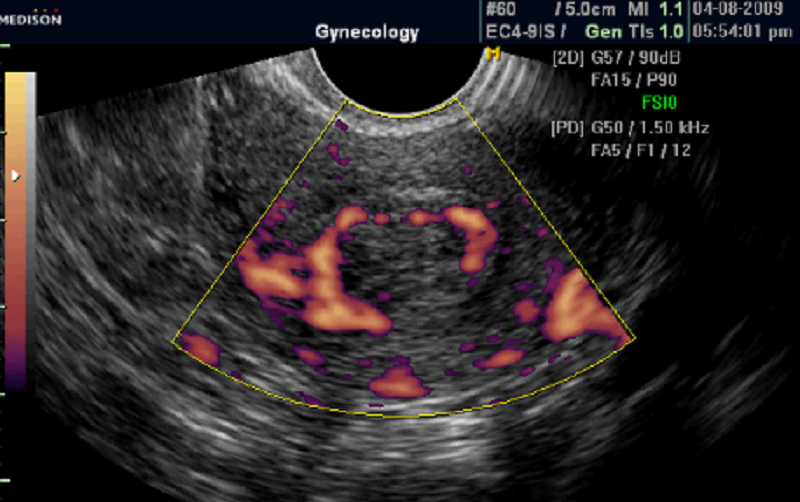
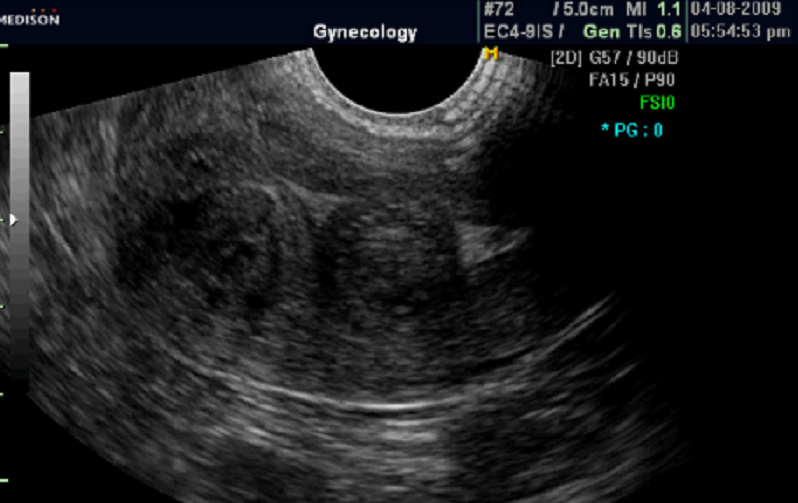
An AV uterus with an ET of 2mm on day 2 is seen. The cavity is not distorted but within the myometrium are multiple small fibroids with the largest measuring 3cm. Left ovary normal. Right ovary normal. No free fluid.

She has been counselled appropriately and has opted for uterine artery embolisation.

Diagnosis

The diagnosis is symptomatic fibroids. This is made by a combination of clinical history and utrasound examination. In addition to diagnosis, ultrasound imaging of the uterus is essential in treatment planning and follow up for UAE. Accurate description of fibroid location and size can also aid counselling in terms of treatment success.

Management Issues

Appreciate the indications and contraindications of uterine artery indication.

Understand the importance of patient selection and the role of ultrasound in doing so.

Discussion

HMB caused by a fibroid uterus can cause significant morbidity for the patient and severely affect her quality of life. In this case it was correct to begin with medical management before moving to surgical management strategies. Her operative background puts her at high risk of operative complications and all options should be discussed before offering an open procedure. Ultrasound assessment can assess suitability for endometrial ablation by estimating uterine size and cavity length and ensuring that the fiborids’ do not cause an endometrial defect thereby reducing the effectiveness of the procedure. Ultrasound scans can be used in patient follow up to ensure fibroid reduction and treatment success.

References

Joint RCOG/RCR 3rd edition: Uterine artery embolisation for the management of fibroids
http://www.rcog.org.uk/files/rcog-corp/23-12-2013_RCOG_RCR_UAE.pdf

NICE guidance: Heavy menstrual bleeding
http://guidance.nice.org.uk/CG44/QuickRefGuide/pdf/English

MR-guided focused ultrasound MRgFUS for symptomatic uterine fibroids: predictors of treatment success. Hum. Reprod. (2012) 27(12): 3425:3431

Clinical outcomes of focused ultrasound surgery for the treatment of uterine fibroids:
Stewart et al. Fertility and Sterility January 2006 pp22-29

Fibroid uterus and Uterine Artery Embolisation

You may wish to answer these questions more than once to improve your score. Following that e-mail admin@bsgi.org.uk requesting the correct answers and explanations.

"*" indicates required fields

This field is hidden when viewing the form
In which of the following situations is the response to UAE least effective?*
Which of the following are not absolute contraindications to UAE?*
Which of the following can ultrasound not accurately comment on?*
When discussing UAE with patients, which of the following statements is NOT true?*
Regarding pre-treatment investigations which of the following statements are correct?*
Which of the following investigations are advised for first line investigation for HMB by NICE?*
Regarding image 1, which type of Doppler function has been applied to the field*
Regarding image 2, which image is NOT true?*
Regarding MRgFUS (magnetic resonance guided focused ultrasound) for the treatment of fibroids, which of the following statements is incorrect?*

Events

We have many events throughout the year, see what's coming up!

View Events

Events

We have many events throughout the year, see what's coming up!

View Events